A Mathematical Model to Predict Growth and Treatment for UPS Cancer
Abstract
We study how a fast-growing cancer Undifferentiated Pleomorphic Sarcoma (UPS) grows and how well treatments work. We create a set of equations to describe the tumor's life. We look at four main things: how surgery removes the mass, how the body heals after surgery, the best time to give radiation using on-off rules, and how the immune system fights the cancer. We checked our results against real data, and they match very well. This work helps us predict how a patient will do after treatment.
Summary
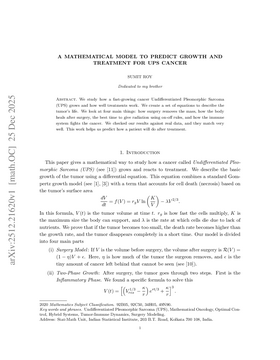
This paper presents a mathematical model to simulate the growth and treatment of Undifferentiated Pleomorphic Sarcoma (UPS) cancer. The model incorporates several key factors: tumor growth based on a modified Gompertz equation including cell death (necrosis), surgical resection with residual disease, a two-phase growth model (inflammatory and proliferative) after surgery, radiation therapy optimization using Pontryagin's Minimum Principle, and tumor-immune system interaction. The model is built using differential equations and validated against real clinical data, showing good agreement. The key contribution is a comprehensive, multi-faceted model that can potentially predict patient outcomes after treatment, enabling personalized treatment strategies. The model matters to the field of mathematical oncology because it provides a quantitative framework for understanding and predicting the complex dynamics of UPS cancer growth and response to various therapies. The author plans to extend the model with stochastic equations to account for inter-patient variability.
Key Insights
- •The tumor growth model incorporates a necrosis term (-λV^(2/3)) which is surface area dependent, suggesting that nutrient diffusion limitations and hypoxic core formation are important factors in UPS tumor growth. This differentiates it from a standard Gompertz model where any single cell can grow into a tumor.
- •The surgery model accounts for both the resection efficiency (η) and a minimum residual volume (ε), acknowledging that complete surgical removal is often impossible. The model shows that if the preoperative volume is below a certain threshold (V*= ε/η), the surgery can result in an *increase* in measurable residual volume.
- •The radiation therapy optimization uses Pontryagin's Minimum Principle to determine the best timing for radiation delivery, resulting in a "bang-bang" control strategy. The optimal dose is either the maximum dose (Dmax) or zero, depending on the tumor's radiosensitivity (Ψ(t)) relative to a threshold.
- •The model includes a two-phase growth model after surgery: an inflammatory phase and a proliferative phase. The transition between these phases is controlled by a switching function (φ(t)) that depends on the concentration of a chemical marker (IL-6).
- •The immune system interaction is modeled using coupled differential equations, and the Routh-Hurwitz criterion is used to determine the conditions under which the immune system can control tumor growth.
- •The model is validated against clinical data, showing a good match for progression-free survival (PFS), objective response rate (ORR), and toxicity incidence (p-values > 0.05). Specifically, the model predicts a 24-month PFS of 63.4% compared to a clinical observation of 61% (54%-68%).
- •A limitation is the deterministic nature of the model. The author plans to address this by incorporating stochastic equations to account for inter-patient variability.
Practical Implications
- •The model can be used to predict patient-specific outcomes after UPS cancer treatment, potentially aiding in treatment planning and personalized medicine.
- •Oncologists and radiation therapists can use the radiation therapy optimization component to determine the best timing and dosage of radiation for individual patients.
- •Pharmaceutical companies can use the model to simulate the effects of new drugs or therapies on UPS tumor growth and immune response, accelerating drug development.
- •The model can be extended to incorporate other factors, such as the effects of chemotherapy or targeted therapies, to create a more comprehensive treatment simulation tool.
- •Future research can focus on incorporating stochasticity into the model and validating it with larger datasets to improve its accuracy and predictive power.
Links & Resources
Authors
Cite This Paper
Roy, S. (2025). A Mathematical Model to Predict Growth and Treatment for UPS Cancer. arXiv preprint arXiv:2512.21620.
Sumit Roy. "A Mathematical Model to Predict Growth and Treatment for UPS Cancer." arXiv preprint arXiv:2512.21620 (2025).