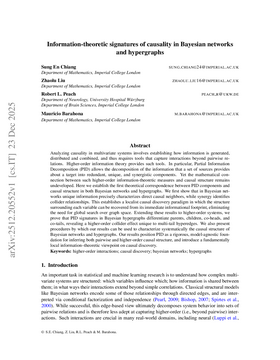
Information-theoretic signatures of causality in Bayesian networks and hypergraphs
Abstract
Analyzing causality in multivariate systems involves establishing how information is generated, distributed and combined, and thus requires tools that capture interactions beyond pairwise relations. Higher-order information theory provides such tools. In particular, Partial Information Decomposition (PID) allows the decomposition of the information that a set of sources provides about a target into redundant, unique, and synergistic components. Yet the mathematical connection between such higher-order information-theoretic measures and causal structure remains undeveloped. Here we establish the first theoretical correspondence between PID components and causal structure in both Bayesian networks and hypergraphs. We first show that in Bayesian networks unique information precisely characterizes direct causal neighbors, while synergy identifies collider relationships. This establishes a localist causal discovery paradigm in which the structure surrounding each variable can be recovered from its immediate informational footprint, eliminating the need for global search over graph space. Extending these results to higher-order systems, we prove that PID signatures in Bayesian hypergraphs differentiate parents, children, co-heads, and co-tails, revealing a higher-order collider effect unique to multi-tail hyperedges. We also present procedures by which our results can be used to characterize systematically the causal structure of Bayesian networks and hypergraphs. Our results position PID as a rigorous, model-agnostic foundation for inferring both pairwise and higher-order causal structure, and introduce a fundamentally local information-theoretic viewpoint on causal discovery.
Summary
This paper addresses the problem of inferring causal relationships in multivariate systems, particularly in scenarios involving higher-order interactions that go beyond pairwise relationships. The authors propose a novel approach based on Partial Information Decomposition (PID) to establish a direct correspondence between information-theoretic measures and causal structure. They demonstrate that PID components, such as unique information and synergy, can characterize causal roles in both Bayesian networks and Bayesian hypergraphs. This approach contrasts with traditional causal discovery methods that rely on global search over graph space, offering a localist perspective where the structure surrounding each variable can be recovered from its immediate informational footprint. The key findings include that unique information in Bayesian networks precisely identifies direct causal neighbors (parents and children), while synergy identifies collider relationships. These results are then extended to Bayesian hypergraphs, demonstrating that PID signatures can differentiate parents, children, co-heads, and co-tails, revealing a higher-order collider effect unique to multi-tail hyperedges. This research matters to the field because it provides a rigorous, model-agnostic foundation for inferring both pairwise and higher-order causal structure, offering a new information-theoretic viewpoint on causal discovery and potentially leading to more efficient algorithms.
Key Insights
- •The paper establishes a formal link between Partial Information Decomposition (PID) components and causal roles in graphical models. Specifically, they show that unique information in PID corresponds to direct causal neighbors (parents and children) in Bayesian networks (Theorem 2).
- •Synergy in PID is shown to identify collider relationships (co-parents sharing a child) in Bayesian networks, allowing for directional causal inference (Theorem 3).
- •The authors extend the PID-based causal discovery framework to Bayesian hypergraphs, demonstrating how PID signatures can capture genuinely higher-order causal structure beyond pairwise graphs (Theorem 4, 5, 6). In hypergraphs, unique information identifies parents, children, and co-heads, while synergy identifies co-tails.
- •The paper introduces the concept of "maximal hyperedge" to provide a canonical representation of hypergraphs, consolidating redundant hyperedge specifications based on PID signatures (Definition 7).
- •The authors address the limitations of multivariate PID by employing a formalism based on bivariate PID, applying it to systems involving *d* variables by building 'supervariables' that contain the complement set of any two variables of interest. This allows them to exploit the well-defined bivariate PID components while maintaining theoretical guarantees.
- •The framework relies on several assumptions, including faithfulness (Assumption 1), non-negative PID atoms (Desideratum 1), monotonicity of unique information (Desideratum 2), persistent relevance (Assumption 2), collider amplification (Assumption 3 and 4), and information monotonicity (Desideratum 3). Violations of these assumptions could affect the accuracy of causal inference.
Practical Implications
- •The research opens up new avenues for causal discovery in complex systems, particularly those with higher-order interactions, such as neural networks, biological systems, and social networks.
- •Researchers and practitioners in machine learning, statistics, and causal inference can benefit from the PID-based causal discovery procedures (Procedure 1 and 2) for Bayesian networks and hypergraphs.
- •The localist perspective offered by this framework can potentially lead to more efficient causal discovery algorithms compared to traditional global search methods. The shared structure of redundancy information allows for reuse across different targets, reducing computational cost.
- •Future research directions include developing efficient estimation strategies for PID measures to enable reliable inference from finite samples and broadening the structural correspondence beyond Bayesian networks and hypergraphs to more expressive causal frameworks.
Links & Resources
Authors
Cite This Paper
Chiang, S. E., Liu, Z., Peach, R. L., Barahona, M. (2025). Information-theoretic signatures of causality in Bayesian networks and hypergraphs. arXiv preprint arXiv:2512.20552.
Sung En Chiang, Zhaolu Liu, Robert L. Peach, and Mauricio Barahona. "Information-theoretic signatures of causality in Bayesian networks and hypergraphs." arXiv preprint arXiv:2512.20552 (2025).