The Transformation of Broadband Demand: From Discretionary Service to Essential Infrastructure (2010-2024)
Abstract
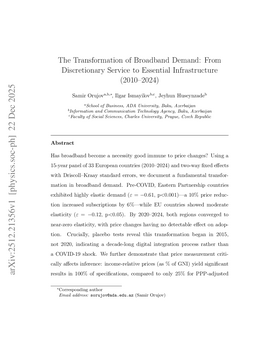
Has broadband become a necessity good immune to price changes? Using a 15-year panel of 33 European countries (2010--2024) and two-way fixed effects with Driscoll--Kraay standard errors, we document a fundamental transformation in broadband demand. Pre-COVID, Eastern Partnership countries exhibited highly elastic demand ($\varepsilon = -0.61$, p$<$0.001) -- a 10\% price reduction increased subscriptions by 6\% -- while EU countries showed moderate elasticity ($\varepsilon = -0.12$, p$<$0.05). By 2020--2024, both regions converged to near-zero elasticity, with price changes having no detectable effect on adoption. Crucially, placebo tests reveal this transformation began in 2015, not 2020, indicating a decade-long digital integration process rather than a COVID-19 shock. We further demonstrate that price measurement critically affects inference: income-relative prices (as \% of GNI) yield significant results in 100\% of specifications, compared to only 25\% for PPP-adjusted prices. These findings have immediate policy relevance: as broadband transitions from discretionary service to essential utility, policy emphasis must shift from affordability subsidies to universal infrastructure deployment.
Summary
This paper investigates the changing price elasticity of broadband demand in 33 European countries (27 EU members and 6 Eastern Partnership countries) from 2010 to 2024. The central research question is whether broadband has transitioned from a discretionary service to an essential infrastructure, becoming less sensitive to price changes. The study employs a panel data analysis using two-way fixed effects models with Driscoll-Kraay standard errors to account for cross-sectional dependence and serial correlation. The key finding is a significant shift in broadband demand elasticity. Before COVID-19, Eastern Partnership countries exhibited high price elasticity (ε = -0.61), while EU countries showed moderate elasticity (ε = -0.12). However, by 2020-2024, both regions converged to near-zero elasticity, indicating that price changes had negligible effects on adoption. Placebo tests further revealed that this transformation began around 2015, suggesting a decade-long digital integration process rather than solely a COVID-19 shock. The study also highlights that using income-relative prices (as % of GNI) yields more consistent and significant results than PPP-adjusted prices. The paper's contribution lies in documenting the time-varying nature of broadband demand elasticity and demonstrating the importance of appropriate price measurement in cross-country comparisons. It challenges the narrative that COVID-19 was the sole driver of the shift in broadband demand, emphasizing the role of long-term digital integration. The findings have significant policy implications, suggesting that as broadband becomes an essential utility, policy emphasis should shift from affordability subsidies to universal infrastructure deployment. This research is crucial for the field because it provides empirical evidence supporting the evolving role of broadband and offers guidance for adapting telecommunications policies to the changing dynamics of digital connectivity.
Key Insights
- •Before COVID-19, Eastern Partnership countries had a significantly higher price elasticity of broadband demand (ε = -0.61, p < 0.001) compared to EU countries (ε = -0.12, p < 0.05).
- •By 2020-2024, both regions converged to near-zero price elasticity, indicating that broadband had become an essential service less sensitive to price changes.
- •Placebo tests revealed that the transformation in broadband demand elasticity began around 2015, challenging the notion that COVID-19 was the sole driver of this shift.
- •The study demonstrates that income-relative prices (as a percentage of GNI) yield more consistent and statistically significant elasticity estimates compared to PPP-adjusted prices, which were significant in only 25% of specifications.
- •The study found that during COVID, the elasticity changed from -0.12 pre-COVID to approximately +0.19 during COVID for EU countries and from -0.61 to approximately -0.03 for EaP countries.
- •The shift from elastic to inelastic demand implies a fundamental change in consumer behavior, where broadband is no longer considered a discretionary expense.
- •A 10% price reduction in EaP countries pre-COVID would have increased subscriptions by approximately 6%, translating to about 900,000 new subscriptions across the region.
Practical Implications
- •As broadband transitions to an essential utility, policymakers should shift focus from affordability subsidies to universal infrastructure deployment and quality standards.
- •Telecommunications policies should be context-dependent, recognizing regional heterogeneity in demand elasticities, particularly between EU and Eastern Partnership countries.
- •Policymakers tracking broadband affordability should prioritize income-relative metrics (price as % of GNI) over nominal prices or PPP-adjusted prices.
- •Future research should focus on supply-side constraints (infrastructure availability, service quality) and other barriers to broadband adoption, such as digital literacy deficits and content relevance.
- •The study opens up avenues for investigating the impact of specific digital inclusion policies and strategies on broadband adoption in different regional and economic contexts.
Links & Resources
Authors
Cite This Paper
Orujov, S., Ismayilov, I., Huseynzade, J. (2025). The Transformation of Broadband Demand: From Discretionary Service to Essential Infrastructure (2010-2024). arXiv preprint arXiv:2512.21356.
Samir Orujov, Ilgar Ismayilov, and Jeyhun Huseynzade. "The Transformation of Broadband Demand: From Discretionary Service to Essential Infrastructure (2010-2024)." arXiv preprint arXiv:2512.21356 (2025).