Structure, Risk, and Access to Credit: Reassessment of the Paycheck Protection Program Effectiveness
Abstract
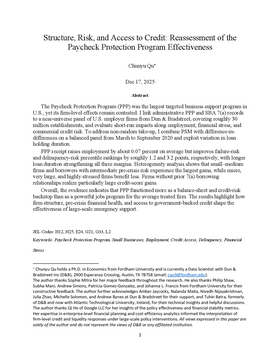
The Paycheck Protection Program (PPP) was the largest targeted business support program in the United States, yet its firm-level effects remain contested. I link administrative PPP and SBA 7(a) records to a near-universe panel of U.S. employer firms from Dun and Bradstreet, covering roughly 30 million establishments, and evaluate short-run impacts on employment, financial stress, and commercial credit risk. To address non-random take-up, I combine propensity score matching with difference-in-differences on a balanced panel from March to September 2020 and exploit variation in loan holding duration. PPP receipt raises employment by about 0.07 percent on average but improves failure-risk and delinquency-risk percentile rankings by roughly 1.2 and 3.2 points, respectively, with longer loan duration strengthening all three margins. Heterogeneity analysis shows that small-to-medium firms and borrowers with intermediate pre-crisis risk experience the largest gains, while micro firms, very large firms, and highly stressed firms benefit less. Firms without prior 7(a) borrowing relationships realize particularly large credit-score gains. Overall, the evidence indicates that PPP functioned more as a balance-sheet and credit-risk backstop than as a powerful jobs program for the average treated firm. The results highlight how firm structure, pre-crisis financial health, and access to government-backed credit shape the effectiveness of large-scale emergency support.
Summary
This paper investigates the effectiveness of the Paycheck Protection Program (PPP) on U.S. firms, focusing on employment, financial stress, and commercial credit risk. The research links administrative PPP and SBA 7(a) records to a near-universe panel of U.S. employer firms from Dun & Bradstreet (D&B), covering roughly 30 million establishments. To address the non-random nature of PPP loan take-up, the author employs a propensity score matching (PSM) with difference-in-differences (DID) approach on a balanced panel from March to September 2020, also exploiting the variation in loan holding duration. The key findings indicate that PPP receipt led to a modest increase in employment (around 0.07%), but significantly improved financial stress and delinquency risk percentile rankings (by approximately 1.2 and 3.2 points, respectively). The effect was more pronounced with longer loan duration. Heterogeneity analysis revealed that small-to-medium firms and those with intermediate pre-crisis risk experienced the largest gains. Interestingly, firms without prior 7(a) borrowing relationships saw particularly large credit-score improvements. The study concludes that PPP primarily served as a balance-sheet and credit-risk backstop rather than a powerful jobs program. This research matters to the field because it provides a comprehensive firm-level evaluation of PPP's impact using a vast dataset and standardized risk scores. It systematically analyzes heterogeneity across various firm characteristics, highlighting how pre-existing financial health and credit access influenced the program's effectiveness. The findings offer valuable insights for designing future emergency business support programs, emphasizing the importance of targeted interventions based on firm size, risk profile, and access to credit.
Key Insights
- •PPP receipt raised employment by about 0.07% on average, but improved failure-risk and delinquency-risk percentile rankings by roughly 1.2 and 3.2 points, respectively.
- •Longer loan duration strengthened all three margins (employment, failure risk, and delinquency risk), suggesting the importance of the liquidity horizon.
- •Small-to-medium firms (10-499 employees) and borrowers with intermediate pre-crisis risk experienced the largest gains in both employment and risk scores.
- •Firms without prior 7(a) borrowing relationships realized particularly large credit-score gains, indicating PPP's role in easing trade-credit constraints for previously less-connected businesses.
- •PPP effects on credit risk were strongest in retail and transportation, food and entertainment, and public administration, sectors most exposed to COVID-19 disruptions.
- •The paper uses a PSM-DID approach on a near-universe dataset of 30 million firms linked to administrative loan data, providing a robust and generalizable analysis.
- •The study reveals that PPP functioned more as a balance-sheet and credit-risk backstop than as a powerful jobs program for the average treated firm, rebalancing the narrative about PPP's effectiveness.
Practical Implications
- •Future emergency business support programs should consider targeting interventions based on firm size, pre-crisis risk levels (using bureau scores), and prior access to credit, rather than relying solely on uniform subsidies.
- •Policymakers should prioritize early and broad information outreach to ensure that viable but less-connected firms can access support quickly, mitigating "first-come, first-served" bias.
- •Maturity structures and forgiveness rules should be differentiated across sectors and risk profiles, with longer horizons for industries facing slower demand recovery or more rigid cost structures.
- •The findings suggest that emergency loan programs, while helpful, do not eliminate structural credit gaps for minority-owned firms, highlighting the need for complementary policies.
- •The study demonstrates the value of integrating commercial credit-bureau data with public loan records for both ex-post evaluation and ex-ante design of crisis response measures.
Links & Resources
Authors
Cite This Paper
Qu, C. (2025). Structure, Risk, and Access to Credit: Reassessment of the Paycheck Protection Program Effectiveness. arXiv preprint arXiv:2512.21547.
Chunyu Qu. "Structure, Risk, and Access to Credit: Reassessment of the Paycheck Protection Program Effectiveness." arXiv preprint arXiv:2512.21547 (2025).