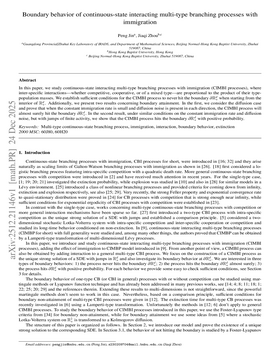
Boundary behavior of continuous-state interacting multi-type branching processes with immigration
Abstract
In this paper, we study continuous-state interacting multi-type branching processes with immigration (CIMBI processes), where inter-specific interactions -- whether competitive, cooperative, or of a mixed type -- are proportional to the product of their type-population masses. We establish sufficient conditions for the CIMBI process to never hit the boundary $\partial\mathbb{R}_{+}^{d}$ when starting from the interior of $\mathbb{R}_{+}^{d}$. Additionally, we present two results concerning boundary attainment. In the first, we consider the diffusion case and prove that when the constant immigration rate is small and diffusion noise is present in each direction, the CIMBI process will almost surely hit the boundary $\partial\mathbb{R}_{+}^{d}$. In the second result, under similar conditions on the constant immigration rate and diffusion noise, but with jumps of finite activity, we show that the CIMBI process hits the boundary $\partial\mathbb{R}_{+}^{d}$ with positive probability.
Summary
This paper investigates the boundary behavior of continuous-state interacting multi-type branching processes with immigration (CIMBI processes). These processes model the evolution of multiple interacting populations where the interactions (competition, cooperation, or mixed) are proportional to the product of the population sizes. The authors aim to determine conditions under which these processes either never hit the boundary (i.e., no population goes extinct), hit the boundary almost surely (all populations eventually go extinct), or hit the boundary with positive probability. The paper uses stochastic analysis techniques, including stochastic differential equations (SDEs) with jumps, Foster-Lyapunov criteria, and comparison principles to analyze the boundary behavior. The authors first establish sufficient conditions for the CIMBI process to remain strictly positive, ensuring that no type goes extinct. They then provide conditions on the immigration rate and diffusion noise under which the process will almost surely or with positive probability hit the boundary, leading to extinction of at least one population type. The analysis considers both diffusion and jump cases, extending existing results for single-type and two-type models to a more general multi-type framework. The key contribution is providing a comprehensive analysis of boundary behavior for a general class of CIMBI processes. This is important because understanding extinction and persistence conditions is crucial for modeling and predicting the dynamics of interacting populations in various fields like ecology, epidemiology, and population genetics. The work builds upon existing literature on CBI processes and Lotka-Volterra systems, providing new tools and insights for analyzing multi-type interacting population models.
Key Insights
- •The paper provides sufficient conditions for a CIMBI process to *never* hit the boundary, ensuring the persistence of all population types, based on the immigration rate being greater than the diffusion rate (ηi > σi).
- •It establishes that under certain conditions on immigration rate (ηi ≤ σi/2) and interaction matrix (either P d i, j=1 c i j σ j y i y j ≤ 0 or negative definite), the CIMBI process *almost surely* hits the boundary in the diffusion case (Theorem 3.2), implying eventual extinction.
- •The paper extends the boundary attainment result to CIMBI processes with finite activity jumps, showing that under similar conditions on immigration and interaction, the boundary is hit with *positive probability* (Theorem 3.4).
- •For competitive interactions (c i j ≤ 0), the condition for boundary attainment can be relaxed to ηi < σi (Theorem 3.5), demonstrating that even with slightly higher immigration, competition can still drive populations to extinction.
- •The proofs rely on a Foster-Lyapunov type criterion for boundary non-attainment and a comparison principle inspired by stochastic Lotka-Volterra systems to establish boundary attainment.
- •The paper improves upon previous results on two-type models by allowing for mixed-type interactions and weakening balance conditions for cooperative interactions.
- •The authors prove the existence and uniqueness of a strong solution to the SDE describing the CIMBI process under a mild condition (2.2), which ensures the mathematical well-posedness of the model.
Practical Implications
- •The results can be applied to modeling the dynamics of interacting species in ecological systems. Understanding the conditions for extinction or persistence is crucial for conservation efforts and predicting the impact of environmental changes.
- •The findings are relevant to epidemiology, where multi-type branching processes can model the spread of different strains of a disease or the interaction between infected and susceptible populations.
- •The mathematical framework and results provide a foundation for further research on multi-type interacting population models, including investigating the long-term behavior of the processes, developing statistical inference methods, and exploring applications in other fields.
- •Practitioners can use the established sufficient conditions to assess the stability and extinction risk of interacting populations based on estimates of immigration rates, diffusion coefficients, and interaction parameters.
- •Future research directions include exploring the impact of stochastic environmental fluctuations on the boundary behavior, developing more refined criteria for boundary attainment and non-attainment, and investigating the convergence to equilibrium distributions.
Links & Resources
Authors
Cite This Paper
Jin, P., Zhou, J. (2025). Boundary behavior of continuous-state interacting multi-type branching processes with immigration. arXiv preprint arXiv:2512.21146.
Peng Jin and Jiaqi Zhou. "Boundary behavior of continuous-state interacting multi-type branching processes with immigration." arXiv preprint arXiv:2512.21146 (2025).