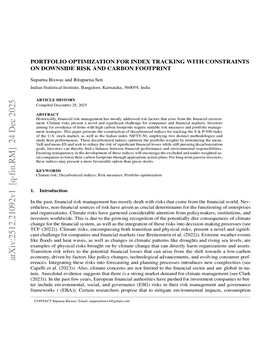
Portfolio Optimization for Index Tracking with Constraints on Downside Risk and Carbon Footprint
Abstract
Historically, financial risk management has mostly addressed risk factors that arise from the financial environment. Climate risks present a novel and significant challenge for companies and financial markets. Investors aiming for avoidance of firms with high carbon footprints require suitable risk measures and portfolio management strategies. This paper presents the construction of decarbonized indices for tracking the S \& P-500 index of the U.S. stock market, as well as the Indian index NIFTY-50, employing two distinct methodologies and study their performances. These decarbonized indices optimize the portfolio weights by minimizing the mean-VaR and mean-ES and seek to reduce the risk of significant financial losses while still pursuing decarbonization goals. Investors can thereby find a balance between financial performance and environmental responsibilities. Ensuring transparency in the development of these indices will encourage the excluded and under-weighted asset companies to lower their carbon footprints through appropriate action plans. For long-term passive investors, these indices may present a more favourable option than green stocks.
Summary
This paper addresses the problem of constructing decarbonized indices (DIs) that track established market benchmarks (S&P 500 and NIFTY 50) while minimizing downside risk and carbon footprint. The authors argue that traditional portfolio optimization based on tracking error and variance is insufficient to mitigate climate risk. They propose two methodologies for constructing DIs: (1) reweighting remaining stocks after excluding the k worst carbon emitters and (2) including all stocks while imposing a threshold on the total carbon footprint. Both methodologies are optimized by minimizing mean-Value-at-Risk (VaR) and mean-Expected Shortfall (ES), which are measures of downside risk. The optimization problem is solved using the Trust-Region Constrained Algorithm (TRCA). The study's key findings show that the resulting DIs significantly reduce carbon footprint compared to the benchmarks. In-sample calculations demonstrate low VaR and ES estimates for the DIs. Out-of-sample performance evaluation reveals that the DIs, on average, outperform the benchmark indices, particularly during significant climate events. For example, the DI based on GHG intensity for NIFTY-50 outperformed the benchmark in 75% of major climate events. The authors conclude that these DIs can protect investors against the timing risk associated with climate mitigation policies. This research matters to the field because it provides a practical and risk-aware approach to constructing investment portfolios that align with both financial performance and environmental responsibility, addressing a growing demand for sustainable investment strategies.
Key Insights
- •The paper proposes a novel approach to portfolio optimization for index tracking by minimizing mean-VaR and mean-ES instead of the traditional tracking error, incorporating downside risk measures directly into the decarbonization process.
- •Two distinct methodologies for constructing decarbonized indices are compared: one that excludes high-carbon emitters and another that constrains the total carbon footprint, offering different trade-offs between diversification and decarbonization.
- •The Trust-Region Constrained Algorithm (TRCA) is used to solve the optimization problem, efficiently handling multiple linear and nonlinear constraints related to portfolio weights and carbon footprint limits.
- •The study uses both greenhouse gas intensity per sale (GHG) and total carbon dioxide emissions (CO2) as proxies for the carbon footprint of stocks, providing a comparative analysis of their impact on portfolio construction.
- •Out-of-sample analysis demonstrates that the constructed decarbonized indices tend to outperform their parent benchmark indices during significant climate events, suggesting a potential hedging effect against climate-related risks.
- •The paper highlights the limitations of relying solely on tracking error minimization for constructing decarbonized indices, as it doesn't explicitly address the risk of financial losses during extreme market events.
- •The study acknowledges limitations regarding the availability and accuracy of carbon emissions data, which may lead to the exclusion of potentially volatile stocks and introduce bias in the measurement process.
Practical Implications
- •The research provides a practical framework for constructing decarbonized investment portfolios that can be implemented by asset managers and institutional investors seeking to reduce their exposure to climate risk.
- •The findings suggest that investors can achieve both financial returns and environmental goals by incorporating downside risk measures and carbon footprint constraints into their portfolio optimization strategies.
- •Policymakers can use the results to estimate the potential impact of carbon pricing on investment portfolios and to incentivize companies to improve their carbon emissions reporting and reduction efforts.
- •The methodologies presented in the paper can be extended to incorporate other ESG (Environmental, Social, and Governance) factors, creating more comprehensive and sustainable investment indices.
- •Future research could focus on improving the accuracy and availability of carbon emissions data, exploring alternative risk measures, and analyzing the long-term performance of decarbonized indices under different climate scenarios.
Links & Resources
Authors
Cite This Paper
Biswas, S., Sen, R. (2025). Portfolio Optimization for Index Tracking with Constraints on Downside Risk and Carbon Footprint. arXiv preprint arXiv:2512.21092.
Suparna Biswas and Rituparna Sen. "Portfolio Optimization for Index Tracking with Constraints on Downside Risk and Carbon Footprint." arXiv preprint arXiv:2512.21092 (2025).