Pluricanonical Geometry of Varieties Isogenous to a Product: Chevalley-Weil Theory and Pluricanonical Decompositions of Abelian Covers
Abstract
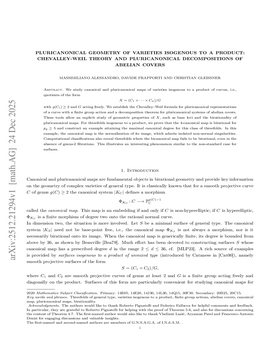
We study canonical and pluricanonical maps of varieties isogenous to a product of curves, i.e., quotients of the form $ X = (C_1 \times \dots \times C_n)/G $ with $g(C_i)\ge 2$ and $G$ acting freely. We establish the Chevalley-Weil formula for pluricanonical representations of a curve with a finite group action and a decomposition theorem for pluricanonical systems of abelian covers. These tools allow an explicit study of geometric properties of $X$, such as base loci and the birationality of pluricanonical maps. For threefolds isogenous to a product, we prove that the 4-canonical map is birational for $p_g \ge 5$ and construct an example attaining the maximal canonical degree for this class of threefolds. In this example, the canonical map is the normalization of its image, which admits isolated non-normal singularities. Computational classifications also reveal threefolds where the bicanonical map fails to be birational, even in the absence of genus-2 fibrations. This illustrates an interesting phenomenon similar to the non-standard case for surfaces.
Summary
This paper investigates the pluricanonical maps of varieties isogenous to a product of curves (VIPs), focusing on the birationality of these maps. The authors establish a Chevalley-Weil formula for pluricanonical representations of a curve with a finite group action and a decomposition theorem for pluricanonical systems of abelian covers. These tools enable a detailed study of geometric properties of VIPs, including base loci and birationality of pluricanonical maps. Specifically, for threefolds isogenous to a product, the authors prove that the 4-canonical map is birational when the geometric genus ($p_g$) is greater than or equal to 5. They also construct an example that attains the maximal canonical degree for this class of threefolds, where the canonical map is the normalization of its image, which exhibits isolated non-normal singularities. Furthermore, computational classifications reveal threefolds where the bicanonical map fails to be birational, even without genus-2 fibrations, highlighting an interesting phenomenon akin to the non-standard case for surfaces. The paper provides a systematic study of canonical and pluricanonical maps of varieties isogenous to a product, extending previous work on surfaces to higher dimensions. The paper makes significant contributions by providing explicit tools and criteria for analyzing the birationality of pluricanonical maps for VIPs, especially in the abelian cover case. The Chevalley-Weil formula for pluricanonical representations and the decomposition theorem for pluricanonical systems of abelian covers are crucial for this analysis. The example of a threefold with a canonical map that is the normalization of its image with isolated non-normal singularities is also a noteworthy result. These findings contribute to the broader understanding of the geometry of varieties of general type and the behavior of their canonical and pluricanonical maps.
Key Insights
- •A Chevalley-Weil formula (Theorem 3.4) is established for pluricanonical representations, providing a way to compute the character of the representation in terms of a generating vector.
- •A decomposition theorem (Theorem 4.7) is proven for pluricanonical systems of abelian covers, allowing for an explicit study of geometric features such as base points. This generalizes previous results for canonical and bicanonical systems.
- •For threefolds isogenous to a product, it is proven that the 4-canonical map is birational if $p_g \ge 5$ (Theorem 5.6).
- •An example is constructed of a regular smooth projective threefold whose canonical map is the normalization map of its image, which has degree 384 and at least one isolated non-normal singularity (Theorem 6.2). This demonstrates that the degree of the image of the canonical map is sharp.
- •Computational classifications reveal threefolds where the bicanonical map fails to be birational, even in the absence of genus-2 fibrations.
- •A character-theoretic necessary condition (Corollary 5.12) is given for the birationality of the m-canonical map based on the irreducible constituents of the character of the m-canonical representation.
- •Proposition 5.13 provides a sufficient criterion for the birationality of the m-canonical map based on the building data of the abelian cover π.
Practical Implications
- •The tools and criteria developed in this paper can be used to analyze the birationality of pluricanonical maps for specific examples of varieties isogenous to a product.
- •Researchers working on birational geometry and the classification of algebraic varieties can benefit from the explicit formulas and algorithms presented in the paper.
- •The computational classifications performed in the paper provide a valuable resource for finding examples of VIPs with specific properties.
- •The work raises the question of whether the base-point freeness of $K_X^{\otimes 2}$ and birationality of $K_X^{\otimes 3}$ hold for all regular unmixed three-dimensional VIPs, which suggests a direction for future research.
- •The study of the failure of birationality of the bicanonical map in the non-standard case opens up new avenues for investigating the geometry of threefolds.
Links & Resources
Authors
Cite This Paper
Alessandro, M., Frapporti, D., Gleissner, C. (2025). Pluricanonical Geometry of Varieties Isogenous to a Product: Chevalley-Weil Theory and Pluricanonical Decompositions of Abelian Covers. arXiv preprint arXiv:2512.21294.
Massimiliano Alessandro, Davide Frapporti, and Christian Gleissner. "Pluricanonical Geometry of Varieties Isogenous to a Product: Chevalley-Weil Theory and Pluricanonical Decompositions of Abelian Covers." arXiv preprint arXiv:2512.21294 (2025).