$\mathcal{K}$-Lorentzian Polynomials, Semipositive Cones, and Cone-Stable EVI Systems
Abstract
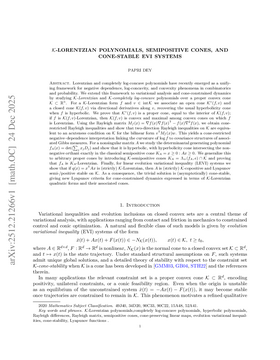
Lorentzian and completely log-concave polynomials have recently emerged as a unifying framework for negative dependence, log-concavity, and convexity in combinatorics and probability. We extend this theory to variational analysis and cone-constrained dynamics by studying $K$-Lorentzian and $K$-completely log-concave polynomials over a proper convex cone $K\subset\mathbb{R}^n$. For a $K$-Lorentzian form $f$ and $v\in\operatorname{int}K$, we define an open cone $K^\circ(f,v)$ and a closed cone $K(f,v)$ via directional derivatives along $v$, recovering the usual hyperbolicity cone when $f$ is hyperbolic. We prove that $K^\circ(f,v)$ is a proper cone and equals $\operatorname{int}K(f,v)$. If $f$ is $K(f,v)$-Lorentzian, then $K(f,v)$ is convex and maximal among convex cones on which $f$ is Lorentzian. Using the Rayleigh matrix $M_f(x)=\nabla f(x)\nabla f(x)^T - f(x)\nabla^2 f(x)$, we obtain cone-restricted Rayleigh inequalities and show that two-direction Rayleigh inequalities on $K$ are equivalent to an acuteness condition for the bilinear form $v^T M_f(x) w$. This yields a cone-restricted negative-dependence interpretation linking the curvature of $\log f$ to covariance properties of associated Gibbs measures. For determinantal generating polynomials, we identify the intersection of the hyperbolicity cone with the nonnegative orthant as the classical semipositive cone, and we extend this construction to general proper cones via $K$-semipositive cones. Finally, for linear evolution variational inequality (LEVI) systems, we show that if $q(x)=x^T A x$ is (strictly) $K$-Lorentzian, then $A$ is (strictly) $K$-copositive and yields Lyapunov (semi-)stability on $K$, giving new Lyapunov criteria for cone-constrained dynamics.
Summary
This paper extends the theory of Lorentzian and completely log-concave polynomials to the realm of variational analysis and cone-constrained dynamics. The authors introduce the concepts of $\mathcal{K}$-Lorentzian and $\mathcal{K}$-completely log-concave polynomials over a proper convex cone $\mathcal{K} \subset \mathbb{R}^n$. For a $\mathcal{K}$-Lorentzian form $f$ and $v \in \operatorname{int} \mathcal{K}$, they define an open cone $\mathcal{K}^\circ(f, v)$ and a closed cone $\mathcal{K}(f, v)$ using directional derivatives along $v$, which recover the usual hyperbolicity cone when $f$ is hyperbolic. They prove that $\mathcal{K}^\circ(f, v)$ is a proper cone and equals $\operatorname{int} \mathcal{K}(f, v)$, and that under certain conditions, $\mathcal{K}(f, v)$ is convex and maximal among convex cones on which $f$ is Lorentzian. The paper also explores Rayleigh inequalities in this cone-constrained setting, using the Rayleigh matrix $M_f(x) = \nabla f(x) \nabla f(x)^T - f(x) \nabla^2 f(x)$. They establish cone-restricted Rayleigh inequalities and demonstrate that two-direction Rayleigh inequalities on $\mathcal{K}$ are equivalent to an acuteness condition for the bilinear form $v^T M_f(x) w$. This leads to a cone-restricted negative dependence interpretation, connecting the curvature of $\log f$ to covariance properties of associated Gibbs measures. Furthermore, for determinantal generating polynomials, the authors identify the intersection of the hyperbolicity cone with the nonnegative orthant as the classical semipositive cone. They extend this construction to general proper cones via $\mathcal{K}$-semipositive cones. Finally, they apply their findings to linear evolution variational inequality (LEVI) systems, showing that if $q(x) = x^T A x$ is (strictly) $\mathcal{K}$-Lorentzian, then $A$ is (strictly) $\mathcal{K}$-copositive and yields Lyapunov (semi-)stability on $\mathcal{K}$, providing new Lyapunov criteria for cone-constrained dynamics. This connects Lorentzian/hyperbolic polynomial geometry with cone-stable dynamics, invariant cones, and hyperbolic barrier methods in a single unified framework.
Key Insights
- •Novel Cone Construction: The paper introduces a novel construction of cones $\mathcal{K}^\circ(f, v)$ and $\mathcal{K}(f, v)$ associated with $\mathcal{K}$-Lorentzian polynomials, generalizing the concept of hyperbolicity cones. Theorem 2.8 shows that $\mathcal{K}^\circ(f, v)$ is the interior of $\mathcal{K}(f, v)$.
- •Cone-Restricted Rayleigh Inequalities: The paper derives cone-restricted Rayleigh inequalities using the Rayleigh matrix $M_f(x)$, linking the curvature of $\log f$ to negative dependence properties. Theorem 3.2 establishes the nonnegativity of $R_u f(x)$ on $\mathcal{K}$ for all $u \in \mathbb{R}^n$.
- •Semipositive Cone Generalization: The classical semipositive cone is generalized to $\mathcal{K}$-semipositive cones for arbitrary proper cones $\mathcal{K}$, connecting hyperbolic geometry with cone-preserving linear maps.
- •Lyapunov Criteria for Cone-Stability: The paper establishes new Lyapunov criteria for cone-stability of LEVI systems based on $\mathcal{K}$-Lorentzian quadratic forms. Theorem 5.12 demonstrates that if $q(x) = x^T A x$ is $\mathcal{K}$-Lorentzian, then $A$ is $\mathcal{K}$-copositive and the trivial solution of the LEVI system is stable with respect to $\mathcal{K}$.
- •Counterintuitive Example: Example 2.14 demonstrates that not all $\mathcal{K}$-Lorentzian polynomials are hyperbolic, and that the cone $\mathcal{K}(f, v)$ may not be convex even when $f$ is Lorentzian. This highlights the subtle differences between these classes of polynomials.
- •Connection to Gibbs Measures: The paper clarifies the role of the Rayleigh matrix $M_f(x)$ as a matrix-valued refinement of scalar Rayleigh differences, with implications for Gibbs measures and log-concave sampling.
- •Acuteness Equivalence: Proposition 3.3 shows that nonnegativity of the two-direction Rayleigh differences $R_{v,w}f(x) \geq 0$ for all $v,w \in \mathcal{K}$ is equivalent to an acuteness condition: the cone $\mathcal{K}$ must be acute with respect to the bilinear form $\langle v, w \rangle_{M_f(x)} = v^T M_f(x) w$.
Practical Implications
- •Cone-Constrained Optimization: The framework provides new tools for analyzing and solving cone-constrained optimization problems, particularly those involving variational inequalities and evolution inclusions.
- •Lyapunov Stability Analysis: The Lyapunov criteria based on $\mathcal{K}$-Lorentzian quadratic forms can be used to analyze the stability of dynamical systems subject to cone constraints, relevant in areas like control theory and mechanics.
- •Hyperbolic Barrier Methods: The connection between $\mathcal{K}$-semipositive cones and hyperbolic generating polynomials opens up new avenues for developing hyperbolic barrier methods for conic optimization. The generating polynomials $f_A$ can be used as natural barrier functions on the semipositive cone $K_A$.
- •Extension of Hyperbolic Programming: The paper suggests the possibility of a broader "$\mathcal{K}$-Lorentzian programming" theory extending hyperbolic programming.
- •Future Research: The open problem of characterizing cones of the form $\mathcal{K}(f, v)$ motivates further research into the geometric properties of $\mathcal{K}$-Lorentzian polynomials and their associated cones.
Links & Resources
Authors
Cite This Paper
Dey, P. (2025). $\mathcal{K}$-Lorentzian Polynomials, Semipositive Cones, and Cone-Stable EVI Systems. arXiv preprint arXiv:2512.21266.
Papri Dey. "$\mathcal{K}$-Lorentzian Polynomials, Semipositive Cones, and Cone-Stable EVI Systems." arXiv preprint arXiv:2512.21266 (2025).