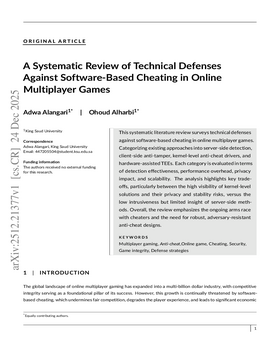
A Systematic Review of Technical Defenses Against Software-Based Cheating in Online Multiplayer Games
Abstract
This systematic literature review surveys technical defenses against software-based cheating in online multiplayer games. Categorizing existing approach-es into server-side detection, client-side anti-tamper, kernel-level anti-cheat drivers, and hardware-assisted TEEs. Each category is evaluated in terms of detection effectiveness, perfor-mance overhead, privacy im-pact, and scalability. The analy-sis highlights key trade-offs, particularly between the high visibility of kernel-level solutions and their privacy and stability risks, versus the low intrusive-ness but limited insight of server-side methods. Overall, the re-view emphasizes the ongoing arms race with cheaters and the need for robust, adversary-resistant anti-cheat designs.
Summary
This paper presents a systematic literature review of technical defenses against software-based cheating in online multiplayer games. The review categorizes existing approaches into server-side detection, client-side anti-tamper techniques, kernel-level anti-cheat drivers, and hardware-assisted Trusted Execution Environments (TEEs). It evaluates each category based on detection effectiveness, performance overhead, privacy impact, and scalability. The authors aim to synthesize and comparatively evaluate the diverse technical defense categories in order to identify promising avenues for future research and to help practitioners make informed decisions regarding the deployment and trade-offs of different anti-cheat strategies. The methodology employed a systematic literature review process, including defining key terms, setting inclusion/exclusion criteria (peer-reviewed English papers from 2019 onwards focusing on software engineering aspects of game security), and implementing a comprehensive search strategy across major databases like IEEE Xplore, ACM Digital Library, Scopus, Web of Science, and ScienceDirect. The screening process followed the PRISMA 2020 framework. The identified papers were then analyzed to answer three research questions: (1) What types of technical defenses exist? (2) How are these defenses empirically evaluated? (3) What are the key tradeoffs and constraints? The key findings emphasize the ongoing "arms race" between game developers and cheaters and the need for a multi-layered, adaptive anti-cheat strategy. The review highlights the trade-offs between privacy and observational power, particularly with kernel-level defenses, which offer high detection effectiveness but raise privacy and stability concerns. Server-side defenses are privacy-friendly but have limited visibility. Hardware-assisted TEEs offer strong integrity but face platform and maintainability constraints. The paper concludes that a combination of server-side behavioral detection and hardware-assisted integrity enforcement represents the most balanced and sustainable path forward.
Key Insights
- •Kernel-level anti-cheat drivers (like Valorant's Vanguard and Fortnite's EAC+BattlEye) are the most effective at proactively blocking injection, patching, and kernel-level cheats because they operate with rootkit-like privileges, but this comes at the cost of significant privacy and stability risks.
- •Server-side behavioral models using deep learning can provide a privacy-preserving, scalable, and tamper-proof layer of defense by detecting the *consequences* of cheating, rather than the mechanisms themselves.
- •Empirical evaluation of anti-cheat systems varies by category. ML-based systems report accuracy, precision, recall, and F1 scores (e.g., CatBoost models achieving F1 scores of 0.9109 to 0.9583 at the race/session level in Mario Kart Wii), while protocol-level defenses are judged by whether they make exploit classes impossible.
- •Hardware-assisted enclaves (e.g., Intel SGX) have not been practically deployed due to high complexity, performance overhead, and platform dependency, despite offering strong integrity guarantees for targeted threats like wallhacks (e.g., BlackMirror demonstrating successful prevention of wallhacks in Quake II by moving visibility logic into SGX).
- •The "Privacy-Effectiveness Paradox" highlights the inherent trade-off: greater effectiveness in anti-cheat solutions often requires higher system privileges, leading to increased risks to user privacy and system stability.
- •The "Adaptation Constraint" emphasizes that any static or signature-based solution will eventually be bypassed due to the adversarial nature of cheating, necessitating a shift towards behavioral and heuristic detection methods.
- •The review found that stronger kernel-level anti-cheats are correlated with higher cheat subscription prices and lower observed cheat uptime, suggesting that robust defenses increase the cost and operational friction for cheaters but do not eliminate cheating entirely.
Practical Implications
- •Game developers should adopt a defense-in-depth strategy, combining kernel-level anti-cheat drivers for proactive blocking with server-side behavioral models for tamper-proof detection.
- •Developers should invest in advancing server-sided detection features and deep learning models, focusing on complex multivariate time series analysis of player input dynamics (HCI data) and avatar trajectory analysis to create unique "digital fingerprints" of authentic human play.
- •Security professionals must establish a policy of radical transparency regarding anti-cheat operations, especially concerning kernel-level access, by publicly communicating policies, procedures, and independently auditing security practices to foster trust among players.
- •Future research should focus on the security and performance implications of cloud gaming, which offers a revolutionary architectural solution by migrating the entire game client execution environment to a trusted, remote server, potentially eliminating the client-side attack vector.
- •The paper introduces the "Adversarial Trust Model," challenging the traditional security boundary in gaming and highlighting the need to assume the client is malicious and focus on the authenticity of player behavior.
Links & Resources
Authors
Cite This Paper
Alangari, A., Alharbi, O. (2025). A Systematic Review of Technical Defenses Against Software-Based Cheating in Online Multiplayer Games. arXiv preprint arXiv:2512.21377.
Adwa Alangari and Ohoud Alharbi. "A Systematic Review of Technical Defenses Against Software-Based Cheating in Online Multiplayer Games." arXiv preprint arXiv:2512.21377 (2025).