Accelerating Underground Pumped Hydro Energy Storage Scheduling with Decision-Focused Learning
Abstract
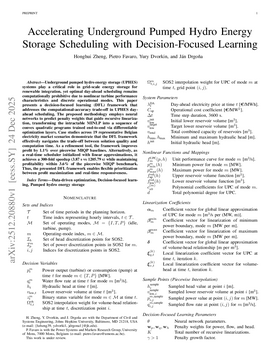
Underground pumped hydro energy storage (UPHES) systems play a critical role in grid-scale energy storage for renewable integration, yet optimal day-ahead scheduling remains computationally prohibitive due to nonlinear turbine performance characteristics and discrete operational modes. This paper presents a decision-focused learning (DFL) framework that addresses the computational-accuracy trade-off in UPHES day-ahead scheduling. The proposed methodology employs neural networks to predict penalty weights that guide recursive linearization, transforming the intractable MINLP into a sequence of convex quadratic programs trained end-to-end via differentiable optimization layers. Case studies across 19 representative Belgian electricity market scenarios demonstrate that the DFL framework effectively navigates the trade-off between solution quality and computation time. As a refinement tool, the framework improves profit by 1.1% over piecewise MIQP baselines. Alternatively, as a real-time scheduler initialized with linear approximations, it achieves a 300-fold speedup (3.87s vs 1205.79s) while maintaining profitability within 3.6% of the piecewise MIQP benchmark. Thus, the presented DFL framework enables flexible prioritization between profit maximization and real-time responsiveness.
Summary
This paper addresses the computationally intensive problem of day-ahead scheduling for Underground Pumped Hydro Energy Storage (UPHES) systems, which are vital for integrating renewable energy sources into the grid. The core challenge lies in the nonlinear turbine performance characteristics and discrete operational modes of UPHES, making optimization using traditional methods computationally prohibitive. The authors propose a decision-focused learning (DFL) framework to overcome this limitation. This framework uses neural networks to predict penalty weights for a recursive linearization process, effectively transforming the complex mixed-integer nonlinear programming (MINLP) problem into a sequence of solvable convex quadratic programs. These penalty weights guide the linearization, creating adaptive trust regions that ensure linearization validity. The neural network is trained end-to-end, leveraging differentiable optimization layers and a physics simulator to evaluate the ex-post operational profit. The effectiveness of the DFL framework is demonstrated through case studies based on 19 representative Belgian electricity market scenarios. The key finding is that the DFL framework successfully balances solution quality and computation time. When used to refine solutions from a piecewise mixed-integer quadratic programming (MIQP) baseline, it improves profit by 1.1%. As a real-time scheduler initialized with linear approximations, it achieves a remarkable 300-fold speedup (reducing computation time from 1205.79 seconds to 3.87 seconds) while keeping profitability within 3.6% of the MIQP benchmark. This work is significant because it offers a practical approach to optimize UPHES scheduling, enabling flexible prioritization between profit maximization and real-time responsiveness, which is crucial for grid stability and renewable energy integration.
Key Insights
- •Novel DFL framework: The paper introduces a novel DFL framework tailored for UPHES scheduling, combining neural networks, recursive linearization, differentiable optimization, and a physics simulator.
- •Neural penalty predictor: The neural network predicts penalty weights that dynamically adjust the trust region size for linearization, ensuring solution feasibility.
- •300x speedup: The DFL framework achieves a 300-fold speedup compared to the piecewise MIQP baseline when used as a real-time scheduler initialized with a global linear approximation.
- •1.1% profit improvement: When used as a refinement tool initialized with a piecewise MIQP baseline, the DFL framework improves ex-post profit by 1.1%.
- •Noise Robustness: The DFL approach maintains near-constant performance across a wide range of initialization noise levels (10%-80%), indicating robustness to errors in initial solutions.
- •Ablation study: An ablation study demonstrated that the neural penalty predictor contributes the most to the performance gain, with recursive linearization providing incremental value. Removing the neural network reduces performance by 2.8%.
- •Simulation Layer: The paper implements a differentiable physics simulator to directly evaluate the ex-post operational profit as training loss, ensuring solution quality over training.
Practical Implications
- •Real-time UPHES scheduling: The framework enables real-time day-ahead scheduling of UPHES systems, making them more responsive to grid demands and electricity market fluctuations.
- •Improved profitability: UPHES operators can use this framework to optimize their scheduling strategies, leading to increased profits by efficiently trading energy in the day-ahead market.
- •Grid stability: By enabling faster and more accurate UPHES scheduling, the framework contributes to grid stability and facilitates the integration of intermittent renewable energy sources.
- •Repurposing infrastructure: The research highlights the potential of UPHES to transform decommissioned mining facilities into energy storage assets.
- •Future research: The authors suggest future research directions, including direct end-to-end learning architectures using physics-informed neural networks and extending the framework to intraday market participation.
Links & Resources
Authors
Cite This Paper
Zheng, H., Favaro, P., Dvorkin, Y., Drgoňa, J. (2025). Accelerating Underground Pumped Hydro Energy Storage Scheduling with Decision-Focused Learning. arXiv preprint arXiv:2512.20880.
Honghui Zheng, Pietro Favaro, Yury Dvorkin, and Ján Drgoňa. "Accelerating Underground Pumped Hydro Energy Storage Scheduling with Decision-Focused Learning." arXiv preprint arXiv:2512.20880 (2025).