Uniform spanning trees and random matrix statistics
Abstract
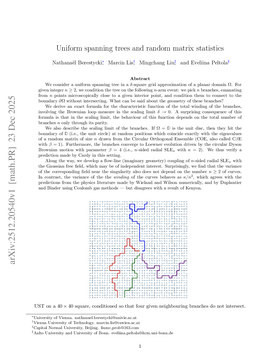
We consider a uniform spanning tree in a $δ$-square grid approximation of a planar domain $Ω$. For given integer $n\ge 2$, we condition the tree on the following $n$-arm event: we pick $n$ branches, emanating from $n$ points microscopically close to a given interior point, and condition them to connect to the boundary $\partial Ω$ without intersecting. What can be said about the geometry of these branches? We derive an exact formula for the characteristic function of the total winding of the branches. A surprising consequence of this formula is that in the scaling limit, the behaviour of this function depends on the total number of branches $n$ only through its parity. We also describe the scaling limit of the branches. If $Ω$ is the unit disc, then they hit the boundary (i.e., the unit circle) at random positions which coincide exactly with the eigenvalues of a random matrix of size $n$ drawn from the Circular Orthogonal Ensemble (COE, also called C$β$E with $β=1$). Furthermore, the branches converge to Loewner evolution driven by the circular Dyson Brownian motion with parameter $β= 4$ (i.e., $n$-sided radial SLE$_κ$ with $κ=2$). We thus verify a prediction made by Cardy in this setting. Along the way, we develop a flow-line (imaginary geometry) coupling of $n$-sided radial SLE$_κ$ with the Gaussian free field, which may be of independent interest. Surprisingly, we find that the variance of the corresponding field near the singularity also does not depend on the number $n\ge 2$ of curves. In contrast, the variance of the the winding of the curves behaves as $κ/n^2$, which agrees with the predictions from the physics literature made by Wieland and Wilson numerically, and by Duplantier and Binder using Coulomb gas methods -- but disagrees with a result of Kenyon.
Summary
This paper investigates the geometry of uniform spanning trees (USTs) on a planar domain approximated by a square grid. The authors focus on the "n-arm event," where *n* branches emanating from a point inside the domain connect to the boundary without intersecting. The main research question is to understand the scaling limit of these branches and their total winding. The approach combines discrete analysis of USTs on the grid with probabilistic tools such as random walk loop soups and Schramm-Loewner evolution (SLE). They derive an exact formula for the characteristic function of the total winding of the branches, showing a surprising dependence on the parity of *n* in the scaling limit. The key findings include the convergence of the UST branches to Loewner evolution driven by circular Dyson Brownian motion and the identification of the boundary hitting points with eigenvalues of a random matrix from the Circular Orthogonal Ensemble (COE). They also establish a flow-line coupling between *n*-sided radial SLE and the Gaussian free field (GFF). This research matters because it provides a rigorous connection between USTs, random matrix theory, and SLE, confirming predictions from physics literature and offering new insights into the geometry of random planar structures. The authors resolve an apparent paradox regarding the variance of the height function associated with the dimer model obtained from the UST.
Key Insights
- •The characteristic function of the total winding of the *n* branches in the scaling limit depends only on the parity of *n*.
- •When the domain is a unit disc, the points where the *n* branches hit the boundary converge to the eigenvalue distribution of a random matrix drawn from the Circular Orthogonal Ensemble (COE).
- •The *n* branches converge to Loewner evolution driven by circular Dyson Brownian motion with parameter β = 4, which is equivalent to *n*-sided radial SLE with κ = 2.
- •They develop a flow-line coupling of *n*-sided radial SLE with the Gaussian free field (GFF), demonstrating a connection to imaginary geometry.
- •The variance of the Gaussian free field near the singularity does *not* depend on the number *n* of curves.
- •The variance of the winding of the curves behaves as κ/n², consistent with predictions from physics literature and differing from a previous result.
- •An exact asymptotic computation of determinants involving random walk excursion kernels enables the derivation of results on the law of total winding.
Practical Implications
- •The results have implications for understanding the behavior of random interfaces and critical phenomena in statistical physics.
- •Researchers in probability, mathematical physics, and computer science can use these findings to develop new algorithms and models for simulating and analyzing random planar structures.
- •The flow-line coupling between SLE and GFF can be used to study the properties of both objects, potentially leading to new insights into their behavior.
- •The rigorous verification of Cardy's prediction provides a foundation for using conformal field theory techniques to study other problems in probability and physics.
- •Future research directions include exploring the connections between USTs, random matrices, and SLE in more general settings, as well as investigating the properties of the flow-line coupling between SLE and GFF in greater detail.
Links & Resources
Authors
Cite This Paper
Berestycki, N., Lis, M., Liu, M., Peltola, E. (2025). Uniform spanning trees and random matrix statistics. arXiv preprint arXiv:2512.20540.
Nathanaël Berestycki, Marcin Lis, Mingchang Liu, and Eveliina Peltola. "Uniform spanning trees and random matrix statistics." arXiv preprint arXiv:2512.20540 (2025).