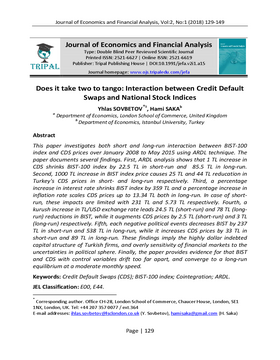
Does it take two to tango: Interaction between Credit Default Swaps and National Stock Indices
Abstract
This paper investigates both short and long-run interaction between BIST-100 index and CDS prices over January 2008 to May 2015 using ARDL technique. The paper documents several findings. First, ARDL analysis shows that 1 TL increase in CDS shrinks BIST-100 index by 22.5 TL in short-run and 85.5 TL in long-run. Second, 1000 TL increase in BIST index price causes 25 TL and 44 TL reducation in Turkey's CDS prices in short- and long-run respectively. Third, a percentage increase in interest rate shrinks BIST index by 359 TL and a percentage increase in inflation rate scales CDS prices up to 13.34 TL both in long-run. In case of short-run, these impacts are limited with 231 TL and 5.73 TL respectively. Fourth, a kurush increase in TL/USD exchange rate leads 24.5 TL (short-run) and 78 TL (long-run) reductions in BIST, while it augments CDS prices by 2.5 TL (short-run) and 3 TL (long-run) respectively. Fifth, each negative political events decreases BIST by 237 TL in short-run and 538 TL in long-run, while it increases CDS prices by 33 TL in short-run and 89 TL in long-run. These findings imply the highly dollar indebted capital structure of Turkish firms, and overly sensitivity of financial markets to the uncertainties in political sphere. Finally, the paper provides evidence for that BIST and CDS with control variables drift too far apart, and converge to a long-run equilibrium at a moderate monthly speed.
Summary
This paper investigates the interaction between the BIST-100 index (Turkey's primary stock market index) and Credit Default Swap (CDS) prices for Turkey, using data from January 2008 to May 2015. The authors employ the Autoregressive Distributed Lag (ARDL) technique to analyze both short-run and long-run relationships. They also use daily data and Granger causality tests. The study incorporates control variables, including inflation, interest rates, exchange rates (TL/USD), and a dummy variable to account for significant negative political events. The key findings demonstrate a significant interplay between the BIST-100 index and CDS prices. Specifically, the ARDL analysis reveals that an increase in CDS prices negatively impacts the BIST-100 index, both in the short and long run. Conversely, an increase in the BIST-100 index leads to a reduction in CDS prices. The study also highlights the sensitivity of Turkish financial markets to changes in the TL/USD exchange rate and political instability. The analysis indicates that Turkish firms' dollar-denominated debt structure contributes to this sensitivity. Furthermore, the error correction models suggest that deviations from the long-run equilibrium between the BIST-100 index and CDS prices are corrected at a moderate monthly speed. This research matters because it provides empirical evidence on the dynamics between stock market performance and credit risk in an emerging market context, particularly highlighting the influence of macroeconomic factors and political events.
Key Insights
- •ARDL analysis shows that a 1 TL increase in CDS prices leads to a 85.5 TL decrease in the BIST-100 index in the long run, while in the short run, a 1 TL increase in CDS prices leads to a 22.5 TL decrease in the BIST-100 index.
- •A 1000 TL increase in the BIST-100 index leads to a 44 TL reduction in CDS prices in the long run, while in the short run, a 1000 TL increase in the BIST-100 index leads to a 25 TL reduction in CDS prices.
- •A 1% increase in the interest rate leads to a 359 TL decrease in the BIST-100 index in the long run, and a 231 TL decrease in the short run. Conversely, a 1% increase in the inflation rate leads to a 13.34 TL increase in CDS prices in the long run and a 5.73 TL increase in the short run.
- •A kurush (1/100 TL) increase in the TL/USD exchange rate leads to a 78 TL decrease in the BIST-100 index and a 3 TL increase in CDS prices in the long run, while leading to a 24.5 TL decrease in the BIST-100 index and a 2.5 TL increase in CDS prices in the short run.
- •Negative political events decrease the BIST-100 index by 538 TL and increase CDS prices by 89 TL in the long run, and decrease the BIST-100 index by 237 TL and increase CDS prices by 33 TL in the short run.
- •The error correction term suggests that the BIST-100 index and CDS prices converge to a long-run equilibrium at a monthly speed of 20.18% for the BIST-dependent model and 37.31% for the CDS-dependent model.
- •The study assumes a linear relationship between the variables and relies on the accuracy of the data sources (Eikon datastream, OECD, and OANDA databases).
Practical Implications
- •The findings are relevant for investors and portfolio managers operating in the Turkish financial market, as they provide insights into the interconnectedness of the stock market and credit risk.
- •Policymakers can use the results to understand the impact of macroeconomic factors and political events on financial stability and develop appropriate measures to mitigate risks.
- •The research highlights the vulnerability of Turkish firms due to their dollar-denominated debt, suggesting the need for policies promoting hedging strategies or reducing reliance on foreign currency borrowing.
- •Future research could explore the impact of specific political events or policy changes on the BIST-100 index and CDS prices, providing a more granular understanding of the dynamics at play.
- •The methodology can be extended to other emerging markets with similar characteristics to assess the robustness of the findings and identify potential differences in the relationship between stock markets and credit risk.
Links & Resources
Authors
Cite This Paper
Sovbetov, Y., Saka, H. (2025). Does it take two to tango: Interaction between Credit Default Swaps and National Stock Indices. arXiv preprint arXiv:2512.07887.
Yhlas Sovbetov and Hami Saka. "Does it take two to tango: Interaction between Credit Default Swaps and National Stock Indices." arXiv preprint arXiv:2512.07887 (2025).