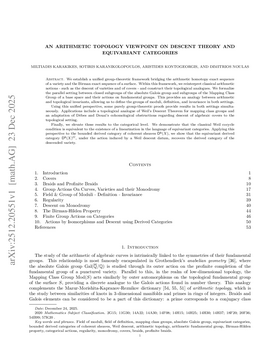
An Arithmetic Topology viewpoint on Descent theory and Equivariant Categories
Abstract
We establish a unified group-theoretic framework bridging the arithmetic homotopy exact sequence of a variety and the Birman exact sequence of a surface. Within this framework, we reinterpret classical arithmetic notions - such as the descent of varieties and of covers - and construct their topological analogues. We formalize the parallel setting between closed subgroups of the absolute Galois group and subgroups of the Mapping Class Group of a base space and their actions on fundamental groups. This provides an analogy between arithmetic and topological invariants, allowing us to define the groups of moduli, definition, and invariance in both settings. Using this unified perspective, some purely group-theoretic proofs provide results in both settings simultaneously. Applications include a topological analogue of Weil's Descent Theorem for mapping class groups and an adaptation of Débes and Douai's cohomological obstructions regarding descent of algebraic covers to the topological setting. Finally, we elevate these results to the categorical level. We demonstrate that the classical Weil cocycle condition is equivalent to the existence of a linearization in the language of equivariant categories. Applying this perspective to the bounded derived category of coherent sheaves $\mathsf{D^b}(X)$, we show that the equivariant derived category $\mathsf{D^b}(X)^G$, under the action induced by a Weil descent datum, recovers the derived category of the descended variety.
Summary
This paper explores the analogy between arithmetic geometry and low-dimensional topology, specifically focusing on descent theory and equivariant categories. The main research question revolves around bridging the gap between the arithmetic homotopy exact sequence of a variety and the Birman exact sequence of a surface, formulating the arithmetic setup of field descent in a purely group-theoretic language, and defining an analogous theory for surfaces. The authors use a group-theoretic framework to reinterpret classical arithmetic notions, such as the descent of varieties and covers, and construct their topological analogues. They formalize the parallel between closed subgroups of the absolute Galois group and subgroups of the Mapping Class Group, and their actions on fundamental groups. The methodology involves transferring concepts from arithmetic geometry to topology and vice versa, using the principle that "fields descend as groups ascend." This includes defining groups of moduli, definition, and invariance in both settings. They elevate these results to the categorical level, demonstrating that the Weil cocycle condition is equivalent to the existence of a linearization in the language of equivariant categories. The key findings include a topological analogue of Weil's Descent Theorem for mapping class groups, an adaptation of Débes and Douai's cohomological obstructions to the topological setting, and a categorical proof of Weil's theorem by constructing a canonical group action on the bounded derived category of coherent sheaves arising from a Weil descent datum. This unified perspective allows for purely group-theoretic proofs that simultaneously yield results in both arithmetic and topology. This matters to the field because it provides a new perspective on descent theory, revealing deep connections between seemingly disparate areas of mathematics.
Key Insights
- •The paper establishes a direct analogy between the arithmetic homotopy exact sequence and the Birman exact sequence, allowing for unified proofs of results like the splitting of these sequences. Proposition A (Proposition 11) shows a splitting condition using a group-theoretic framework applicable to both settings.
- •The authors demonstrate that regularity of covers, an arithmetic condition, can be characterized by a purely group-theoretic condition of index preservation: `[Π_A : H] = [Π_1 : R]` (Proposition 50), enabling the study of regularity in topology where no base field exists.
- •A key insight is the formulation of a topological analogue to Weil's descent theorem (Theorem A, Theorem 46), which transforms the arithmetic descent problem into a topological ascent problem involving extending the definition of a cover from a group *A* to a larger group *A'*.
- •The paper identifies the cohomological obstructions to descending an arithmetic cover to its field of moduli in Section 7 and shows that these obstructions apply verbatim to the topological group ascent of covers (Theorems 57, 58).
- •The authors demonstrate that the Weil cocycle condition, crucial for the descent of varieties, can be naturally expressed as a linearization in the language of equivariant categories (Proposition 67).
- •The paper extends the descent formalism to the bounded derived category `D^b(X)`, treating it as a geometric object subject to Galois actions, providing a categorical proof of Weil's theorem (Proposition 74).
- •By lifting the Weil descent datum from a variety *X* to its derived category, the authors show that the equivariant derived category `D^b(X)^G` recovers the derived category of the descended variety `D^b(Y)` (Theorem F, Propositions 69, 72, & 74).
Practical Implications
- •The unified framework can potentially simplify proofs and provide new insights in both arithmetic geometry and topology by allowing researchers to leverage results from one field to inform the other.
- •Researchers working on descent theory, moduli spaces, and mapping class groups can benefit from the new perspective and tools provided in this paper.
- •The explicit topological analogue of Weil's descent theorem (Theorem A, Theorem 46) can be used to study covers of surfaces and their symmetries in a more systematic way.
- •The results on equivariant categories and derived categories (Theorem F, Propositions 69, 72, & 74) can be applied to study the geometry of quotient stacks and their relationship to the original varieties.
- •The identification of cohomological obstructions to descent (Theorems 57, 58) opens up new avenues for constructing covers with specific properties, such as having a group of moduli strictly larger than the group of definition.
Links & Resources
Authors
Cite This Paper
Karakikes, M., Karanikolopoulos, S., Kontogeorgis, A., Noulas, D. (2025). An Arithmetic Topology viewpoint on Descent theory and Equivariant Categories. arXiv preprint arXiv:2512.20551.
Miltiadis Karakikes, Sotiris Karanikolopoulos, Aristides Kontogeorgis, and Dimitrios Noulas. "An Arithmetic Topology viewpoint on Descent theory and Equivariant Categories." arXiv preprint arXiv:2512.20551 (2025).