Nondimensionalization is more science than art
Abstract
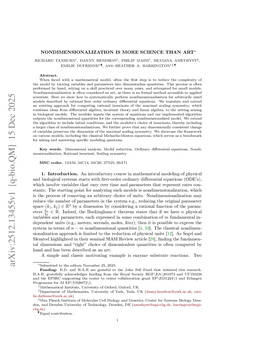
When faced with a mathematical model, often the first step is to reduce the complexity of the model by turning variables and parameters into dimensionless quantities. This process is often performed by hand, relying on a skill practiced over many years, and attempted for small models. Nondimensionalization is often considered an art, as there is no formal method accessible to applied scientists. Here we show how to systematically perform nondimensionalization for arbitrarily sized models described by rational first order ordinary differential equations. We translate and extend an existing approach for computing rational invariants of the maximal scaling symmetry, which combines ideas from differential algebra, invariant theory and linear algebra, to the setting arising in biological models. The modeler inputs the system of equations and our implemented algorithm outputs the nondimensional quantities for the corresponding nondimensionalized model. We extend the algorithm to include initial conditions, and the modeler's choice of invariants, thereby including a larger class of nondimensionalizations. We further prove that any dimensionally consistent change of variables preserves the dimension of the maximal scaling symmetry. We showcase the framework on various models, including the classical Michaelis-Menten equations, which serves as a benchmark for asking and answering specific modeling questions.
Summary
The paper addresses the challenge of nondimensionalization in mathematical modeling, particularly for biological systems described by ordinary differential equations (ODEs). Nondimensionalization simplifies models by reducing the number of parameters and variables, but it's often considered an "art" due to the lack of systematic methods. This paper presents an algorithmic approach to nondimensionalization, treating it as a more scientific process. The authors extend an existing method for computing rational invariants of the maximal scaling symmetry, combining differential algebra, invariant theory, and linear algebra. The core idea involves translating ODE models into a form suitable for algorithmic processing. The algorithm takes the system of equations as input and outputs nondimensional quantities for the corresponding nondimensionalized model. Enhancements include handling initial conditions and allowing modeler-specified invariants. A key theoretical contribution is proving that dimensionally consistent changes of variables preserve the dimension of the maximal scaling symmetry. The authors demonstrate the framework on various models, including the Michaelis-Menten equations, and provide a Python software library called `desr` for implementation. The work unifies classical nondimensionalization with an algebraic algorithmic approach, incorporating both physical and structural units.
Key Insights
- •The paper presents a systematic and algorithmic approach to nondimensionalization, moving it away from being a purely manual and experience-based "art."
- •The algorithm is based on computing rational invariants of the maximal scaling symmetry, leveraging tools from differential algebra, invariant theory, and linear algebra.
- •The authors extend the Hubert-Labahn algorithm to include initial conditions and modeler-defined invariants, allowing for a wider range of nondimensionalizations. The incorporation of initial conditions can be achieved by treating the ratio between the variable and its initial value as a scaling invariant.
- •The authors prove that any dimensionally consistent change of variables preserves the dimension of the maximal scaling symmetry, a key theoretical result ensuring consistency across different model representations.
- •The paper includes a Python implementation (`desr`) making the approach accessible to applied scientists.
- •The method recovers standard nondimensionalizations of well-known models like Michaelis-Menten kinetics and can also generate alternative formulations.
- •The authors introduce the concept of "structural fundamental units" which can lead to more reduction than traditional dimensional analysis based solely on physical fundamental units.
Practical Implications
- •The algorithmic approach can be applied to a wide range of mathematical models described by rational first-order ODEs, particularly in systems biology.
- •Researchers and engineers can use the `desr` library to automate the nondimensionalization process, reducing the manual effort and potential for errors.
- •The ability to incorporate initial conditions and modeler-defined invariants allows for tailoring the nondimensionalization to specific modeling questions and constraints.
- •The framework can help identify key dimensionless parameters that govern the behavior of the system, leading to better understanding and prediction.
- •Future research directions include extending the method to handle more complex models, such as those involving partial differential equations or stochastic processes.
Links & Resources
Authors
Cite This Paper
Tanburn, R., Hendron, D., Maini, P., Amethyst, S., Dufresne, E., Harrington, H. A. (2025). Nondimensionalization is more science than art. arXiv preprint arXiv:2512.13455.
Richard Tanburn, Danny Hendron, Philip Maini, Silviana Amethyst, Emilie Dufresne, and Heather A. Harrington. "Nondimensionalization is more science than art." arXiv preprint arXiv:2512.13455 (2025).