Estimating Program Participation with Partial Validation
Abstract
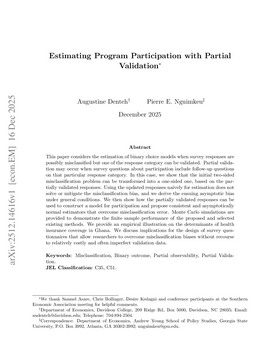
This paper considers the estimation of binary choice models when survey responses are possibly misclassified but one of the response category can be validated. Partial validation may occur when survey questions about participation include follow-up questions on that particular response category. In this case, we show that the initial two-sided misclassification problem can be transformed into a one-sided one, based on the partially validated responses. Using the updated responses naively for estimation does not solve or mitigate the misclassification bias, and we derive the ensuing asymptotic bias under general conditions. We then show how the partially validated responses can be used to construct a model for participation and propose consistent and asymptotically normal estimators that overcome misclassification error. Monte Carlo simulations are provided to demonstrate the finite sample performance of the proposed and selected existing methods. We provide an empirical illustration on the determinants of health insurance coverage in Ghana. We discuss implications for the design of survey questionnaires that allow researchers to overcome misclassification biases without recourse to relatively costly and often imperfect validation data.
Summary
This paper addresses the problem of misclassification in binary choice models, a common issue in survey data regarding program participation, health insurance, and other areas. The authors focus on a specific scenario: partial validation, where responses are verified for only one category of the binary outcome (e.g., verifying insurance coverage only for those who initially report having it). They demonstrate that partial validation transforms the two-sided misclassification problem into a one-sided one, where the primary concern becomes false negatives. Critically, they show that naively using the partially validated data in standard binary choice models *does not* eliminate bias and can even lead to sign reversals in estimated effects. To address this, the authors propose two Maximum Likelihood Estimators (MLEs) based on partial observability models. These estimators exploit the structure created by partial validation to consistently estimate the binary choice model parameters, even when misclassification is endogenous (correlated with both the true outcome and covariates). They establish the consistency and asymptotic normality of these estimators and assess their finite sample performance through Monte Carlo simulations. The paper culminates in an empirical illustration using data on health insurance coverage in Ghana, demonstrating the practical implications of misclassification bias and the effectiveness of the proposed estimators. The authors emphasize that incorporating verification questions in survey design can significantly improve the accuracy of estimates without relying on costly and potentially imperfect external validation data.
Key Insights
- •Partial validation transforms two-sided misclassification into a one-sided (false negative) problem: This simplifies the modeling process but doesn't eliminate bias if standard methods are used.
- •Naive use of partially validated data can worsen bias: The paper provides theoretical expressions for the asymptotic bias resulting from using either the originally reported or the partially validated measure. Theorem 2 shows that the bias is generally unknown but the sign of the bias in a dummy explanatory variable will always be negative.
- •The proposed Partial Partial Observability MLE (PPO MLE) and Partial Observability MLE (PO MLE) are consistent under endogenous misclassification: These estimators leverage the partial observability framework to address covariate-dependent and correlated misclassification errors.
- •Monte Carlo simulations demonstrate the superior performance of the proposed estimators: Existing methods, including those assuming conditionally random misclassification (e.g., Hausman et al., 1998), exhibit significant bias, while the PO MLE and PPO MLE consistently estimate the true parameters.
- •The PPO MLE is generally more efficient than the PO MLE: The PPO MLE uses more information (observing the initial report), leading to smaller variances in parameter estimates, as shown in the Monte Carlo results (Table 2). Ratios of variances often exceed one, indicating higher efficiency for PPO.
- •The paper relaxes the common assumption of conditionally random misclassification: The framework allows for endogenous misclassification, where the decision to misreport is correlated with both the true outcome and covariates.
- •Identification relies on exclusion restrictions: At least one covariate in the misreporting model (z) must be excluded from the true participation model (x), and vice-versa.
Practical Implications
- •Improved survey design: The research highlights the value of including verification questions in surveys, even for just one response category, to mitigate misclassification bias.
- •More accurate program evaluation: Researchers and policymakers can use the proposed estimators to obtain more reliable estimates of program participation rates and the determinants of participation, leading to better-informed policy decisions.
- •Applicable to various binary choice contexts: The methodology extends beyond program participation to other areas where binary outcomes are subject to misclassification, such as health insurance coverage, employment status, and voting behavior.
- •Provides a practical alternative to external validation data: The paper offers a way to overcome misclassification biases without resorting to costly and often imperfect administrative data.
- •Future research: The authors suggest further exploration of semiparametric estimation methods and the development of more flexible models for the joint distribution of error terms.
Links & Resources
Authors
Cite This Paper
Denteh, A., Nguimkeu, P. E. (2025). Estimating Program Participation with Partial Validation. arXiv preprint arXiv:2512.14616.
Augustine Denteh and Pierre E. Nguimkeu. "Estimating Program Participation with Partial Validation." arXiv preprint arXiv:2512.14616 (2025).