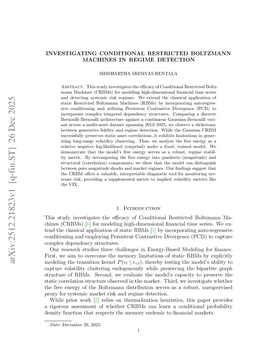
Investigating Conditional Restricted Boltzmann Machines in Regime Detection
Abstract
This study investigates the efficacy of Conditional Restricted Boltzmann Machines (CRBMs) for modeling high-dimensional financial time series and detecting systemic risk regimes. We extend the classical application of static Restricted Boltzmann Machines (RBMs) by incorporating autoregressive conditioning and utilizing Persistent Contrastive Divergence (PCD) to incorporate complex temporal dependency structures. Comparing a discrete Bernoulli-Bernoulli architecture against a continuous Gaussian-Bernoulli variant across a multi-asset dataset spanning 2013-2025, we observe a dichotomy between generative fidelity and regime detection. While the Gaussian CRBM successfully preserves static asset correlations, it exhibits limitations in generating long-range volatility clustering. Thus, we analyze the free energy as a relative negative log-likelihood (surprisal) under a fixed, trained model. We demonstrate that the model's free energy serves as a robust, regime stability metric. By decomposing the free energy into quadratic (magnitude) and structural (correlation) components, we show that the model can distinguish between pure magnitude shocks and market regimes. Our findings suggest that the CRBM offers a valuable, interpretable diagnostic tool for monitoring systemic risk, providing a supplemental metric to implied volatility metrics like the VIX.
Summary
This paper investigates the use of Conditional Restricted Boltzmann Machines (CRBMs) for modeling high-dimensional financial time series and detecting systemic risk regimes. The authors extend the classical static RBM by incorporating autoregressive conditioning and Persistent Contrastive Divergence (PCD) to capture temporal dependencies. They compare a discrete Bernoulli-Bernoulli CRBM against a continuous Gaussian-Bernoulli variant using a multi-asset dataset from 2013 to 2025. The study reveals a trade-off between generative fidelity and regime detection. The Gaussian CRBM excels at preserving static asset correlations but struggles to generate long-range volatility clustering and heavy tails. The authors then analyze the free energy of the trained models, interpreting it as a relative negative log-likelihood (surprisal). They demonstrate that the free energy of the Gaussian CRBM can serve as a robust regime stability metric. By decomposing the free energy into quadratic (magnitude) and structural (correlation) components, the model can differentiate between pure magnitude shocks and market regimes. The paper concludes that CRBMs, particularly the Gaussian variant, offer a valuable and interpretable tool for monitoring systemic risk, providing a complementary metric to implied volatility measures like the VIX. The authors emphasize that the CRBM's ability to capture structural regime shifts in an unsupervised manner makes it a potentially useful diagnostic tool for financial markets, even if its generative capabilities are limited.
Key Insights
- •The Gaussian-Bernoulli CRBM better preserves static asset correlations compared to the Bernoulli-Bernoulli CRBM due to the continuous latent space, eliminating the information loss caused by discretization.
- •The Bernoulli-Bernoulli CRBM suffers from "Hamming Cliffs" in the binary encoding, hindering gradient descent and preventing the model from learning subtle correlations.
- •The free energy of the Gaussian-Bernoulli CRBM, when decomposed, allows differentiating between periods of market stress dominated by large return magnitudes and those coinciding with deviations in learned cross-asset features. The structural term of the free energy drops sharply during a market crash, indicating the model recognizes a distinct "crisis regime."
- •The quadratic term in the Gaussian CRBM's free energy acts as a proxy for realized volatility, mirroring the VIX index during the 2020 crash.
- •The paper identifies limitations of the CRBM, including the assumption of conditional independence across time given a finite lag window, the lack of an internal latent state for generating true dynamical persistence, and the use of Gaussian visible units that preclude accurate modeling of heavy-tailed return distributions.
- •The authors used a lag of N=5 for the autoregressive conditioning, allowing the model to capture short-term memory.
- •The Bernoulli-Bernoulli CRBM assigns near-certain probabilities to all observed states, failing to differentiate between normal market days and crisis days.
Practical Implications
- •The Gaussian-Bernoulli CRBM can be used as a diagnostic tool for systemic risk monitoring in financial markets, providing a supplemental metric to implied volatility measures like the VIX.
- •Financial practitioners and risk managers can use the decomposed free energy to gain a deeper understanding of market stress, distinguishing between episodes driven by pure magnitude shocks and those involving structural changes in asset correlations.
- •Future research should focus on exploring heavy-tailed energy functions (e.g., Student-t distributions or Huber loss) to improve the model's ability to capture extreme events and address the "thin tail" problem.
- •Deep Belief Networks (DBNs) with stacked RBMs could be used to learn hierarchical features and capture slower-moving regime variables, while lower layers handle high-frequency noise.
- •The CRBM framework can be extended to other domains with high-dimensional time series data where regime detection and anomaly detection are important.
Links & Resources
Authors
Cite This Paper
Rentala, S. S. (2025). Investigating Conditional Restricted Boltzmann Machines in Regime Detection. arXiv preprint arXiv:2512.21823.
Siddhartha Srinivas Rentala. "Investigating Conditional Restricted Boltzmann Machines in Regime Detection." arXiv preprint arXiv:2512.21823 (2025).